
Short answer first
Most of the time, a garage door that won't open is caused by one of three things: a dead photo-eye sensor, a broken spring, or the opener itself losing power or connection. A technician checks these in a specific order because it's the fastest way to rule things out without taking the door apart. Here's that order, and what each fix actually involves.
What you're probably seeing
Before the causes, it helps to know which symptom you have, because it points to a different part of the system:
- Nothing happens at all — no light, no hum, no click when you press the button or remote.
- The opener hums or clicks but the door doesn't move.
- The door starts to open, then stops or reverses partway up.
- The door won't budge even when you try to lift it by hand with the opener disconnected.
- The opener runs through its full motion, but the door stays in place — the carriage moves along the rail but nothing is attached to it.
Keep your symptom in mind as you read the list below.
The order a technician checks things
1. Power to the opener
First check is always the simplest: is the opener actually getting power? A tripped breaker, an unplugged cord, or a GFC outlet that tripped from a nearby storm or humidity intrusion will stop everything cold with no warning lights. After heavy rain or a lightning-heavy afternoon, this is worth checking before anything else — surges from storm season are common enough that it's step one, not an afterthought.
2. Safety sensors (photo eyes)
If the opener has power but the door won't close, or closes partway and reverses, the photo-eye sensors near the bottom of the tracks are the next stop. These small sensors need a clear, aligned line of sight to each other. Salt air and humidity along the coast cause condensation and corrosion on the lenses and brackets faster than it would inland, and spiderwebs or dust can block the beam just enough to confuse the system. The fix is usually cleaning the lenses and re-aligning the brackets so the small indicator light on each sensor stays solid instead of blinking.
3. Remote and wall control
Dead batteries, a remote that's lost its programming, or interference are checked next, especially if the wall button works but the remote doesn't (or vice versa). This is a quick elimination step before moving to anything mechanical.
4. Springs
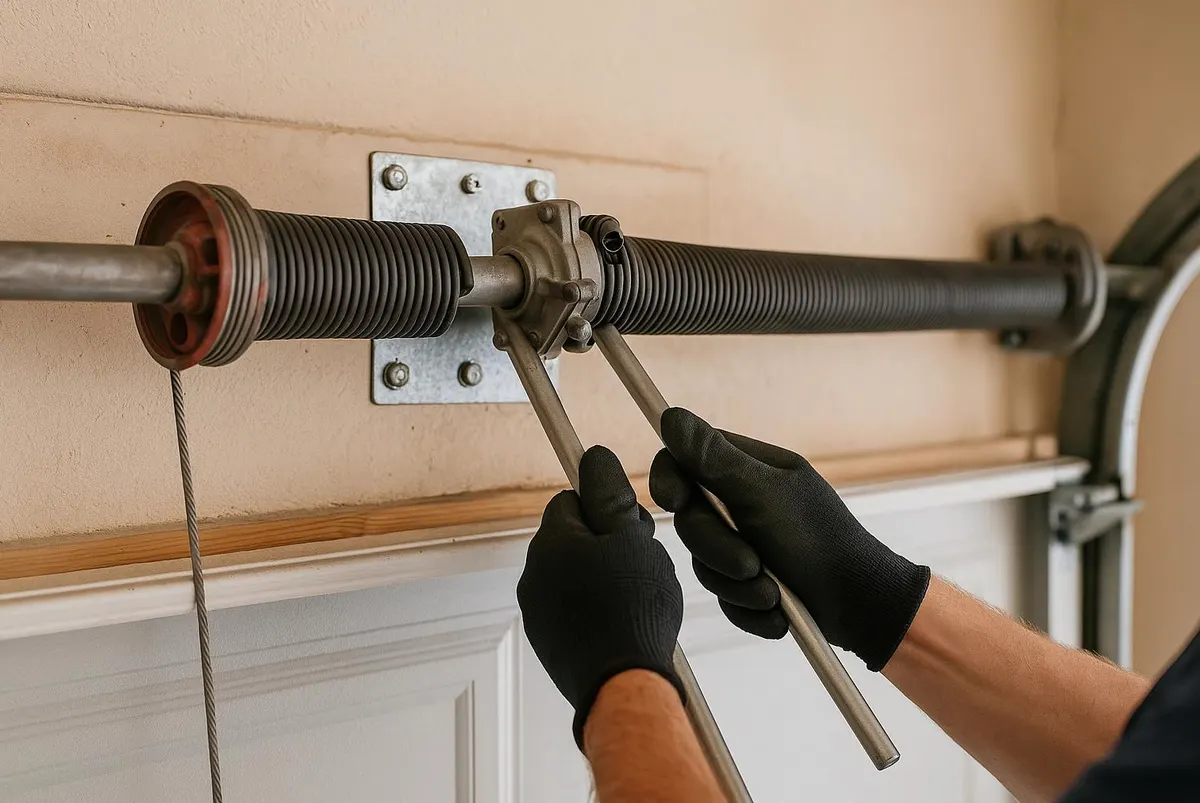
If the door won't move even when you disconnect the opener and try lifting by hand, the spring is the prime suspect. A broken torsion or extension spring makes the door suddenly feel like it weighs twice as much, and often there's a loud bang at the moment it let go, sometimes hours or days earlier. Technicians check this early because it's one of the most common failures and because a broken spring under tension is genuinely dangerous to handle without the right bars and clamps. The fix is a full spring replacement, matched to the door's weight and cycle count, not just a patch.
5. Track alignment and rollers
Next comes a visual check of the tracks for gaps, bends, or rollers that have jumped the rail. Humidity swelling in wood door frames, minor impacts, or debris from an afternoon downpour can nudge a door off track just enough to bind it. The fix ranges from re-tightening track bolts and lubricating rollers to straightening or replacing a bent section of track.
6. Opener trolley and manual release
If the opener runs but the door doesn't move with it, the trolley carriage on the rail may have disconnected from the door arm, usually from the manual release cord being pulled (sometimes by accident, sometimes intentionally during a power outage) and never reconnected. This is a quick reset in most cases.
7. Drive mechanism and motor
Last on the list because it's the most involved: a worn drive belt or chain, stripped gears, or a failing motor. These wear gradually, so by the time they fail completely there are usually earlier warning signs — grinding noises, slower movement, or the door stopping at the same spot every time. The fix here is either a belt/chain replacement or a full opener replacement if the motor itself has failed, which is common on openers that have been running for many years in a humid, salt-air environment.
When to call Precision Garage Door of East Point
If you've checked power and the remote and the door still won't open, or if you hear that telltale bang and the door suddenly feels too heavy to lift, stop trying to force it. A broken spring under tension isn't a DIY repair, and neither is an off-track door once the rollers have come loose from the rail. Our technicians handle both Garage Door Spring Repair and Off Track Door Repair as same-type calls we run constantly in this area, where salt air and humidity put extra wear on springs, hinges, and track hardware faster than they would further inland. We'll diagnose it using the same order of checks above, show you what failed, and get the door back in service without guesswork.
If your garage door in East Point, Apalachicola, Carrabelle, St. George Island, Port St. Joe, or Mexico Beach won't open, call Precision Garage Door of East Point. We'll send a technician out, find the actual cause, and fix it right the first time.